

 0
 0
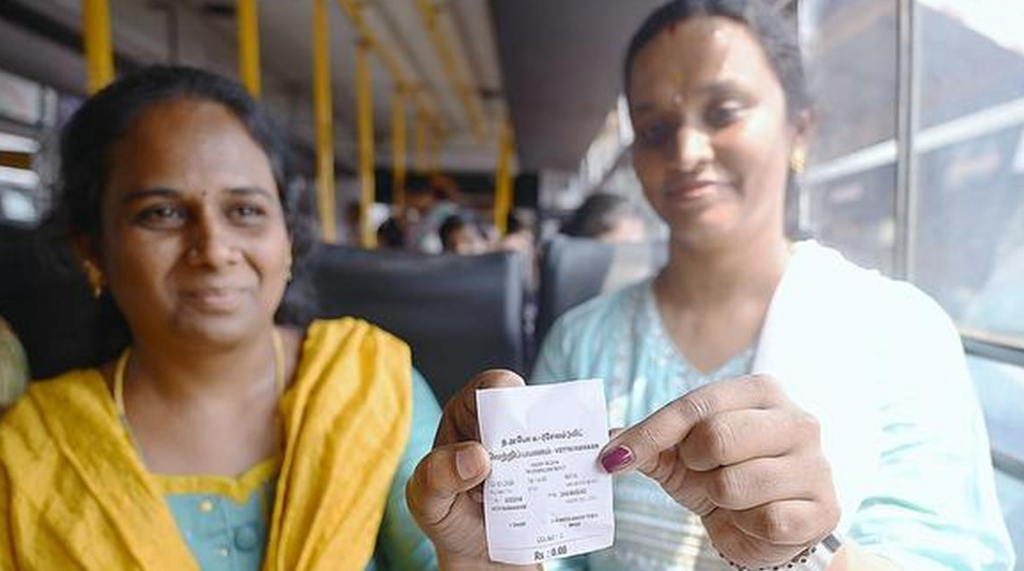
Tamil Nadu’s expanded Vettri Payanam free bus travel scheme has put an old policy question under a new spotlight: how much economic value can a free ride create?
Launched on October 2, 2026, the expanded scheme allows women and transgender persons to travel free on a much wider network of government buses across Tamil Nadu. The programme now covers 12,695 buses, with an estimated 84.32 lakh women expected to benefit every day. The annual cost to the state government is estimated at around ₹6,000 crore.
At first glance, the calculation appears straightforward. The government spends thousands of crores to eliminate bus fares for millions of passengers.
But the real economic question is more complicated.
If free mobility allows women to reach jobs, colleges, markets and healthcare more easily, the benefit could extend far beyond the value of the ticket. The challenge for Tamil Nadu is to demonstrate that these social benefits translate into measurable economic returns.
What Is Vettri Payanam?
Vettri Payanam, meaning “victorious journey”, is an expansion of Tamil Nadu’s existing women-focused free bus travel programme.
Previously, free travel was largely limited to ordinary city and town buses, along with certain hill services. The expanded programme now includes Express, Limited Stop Service, Deluxe, Mofussil Ordinary and eligible Ghat Ordinary services operated by the state’s transport corporations.
The expansion significantly increases the geographical reach of free travel.
According to government figures, the programme covers roughly 69% of the buses operated by the state’s seven transport corporations. Around 1,68,500 single trips are expected to operate under the scheme each day.
There is also no income ceiling or daily trip limit for eligible beneficiaries.
That makes Vettri Payanam more than a narrowly targeted subsidy. It is a large-scale public transport intervention.
The ₹6,000 Crore Question
The biggest economic issue is the cost.
The expanded free travel programme is expected to cost Tamil Nadu around ₹6,000 crore annually. The expansion itself is estimated to add roughly ₹1,600 crore a year to the previous expenditure.
That is a substantial public expenditure.
However, looking only at the fiscal cost misses one important point: public transport subsidies can create benefits that do not appear directly in a transport corporation’s balance sheet.
A woman who saves ₹30 or ₹50 on a bus journey may use that money for food, education, healthcare or household expenses. A worker who can travel farther at no cost may be able to accept a job that was previously uneconomical because of commuting expenses.
The economic return, therefore, depends on what passengers do with the mobility that the government has effectively purchased for them.
Free Travel Can Increase Women’s Mobility
Transport costs can be a significant barrier to mobility, particularly for low-income workers, students and women with limited access to private vehicles.
Removing the fare lowers the cost of travelling to work, school, hospitals and markets.
This matters because employment opportunities are not distributed evenly across neighbourhoods.
A woman living outside an industrial or commercial centre may have access to more jobs if commuting becomes cheaper. The same principle applies to students travelling to colleges and patients travelling to hospitals.
The government has explicitly positioned the expanded scheme as a measure intended to prevent transport costs from restricting women’s access to education, employment and essential services.
The next question is whether increased mobility actually translates into higher employment and income.
The Earlier Scheme Offers Some Clues
Tamil Nadu’s earlier free bus programme provides useful evidence about the potential household impact.
A Tamil Nadu State Planning Commission study cited in recent reporting found that women in Madurai, Tiruppur and Nagapattinam saved an average of around ₹888 per month through free bus travel. For some lower-income groups, including street vendors, construction workers and domestic workers, the savings represented a meaningful share of monthly income.
An independent 2024 study by the Citizen Consumer and Civic Action Group also reported monthly savings of roughly ₹601-800 among surveyed women in six Tamil Nadu cities. The study found that some women redirected those savings towards household needs such as health and education.
These figures suggest that the value of free transport is not limited to the fare itself.
For a low-income household, relatively small daily savings can accumulate into a meaningful monthly amount.
The Labour-Market Effect Could Be Bigger
The most important potential economic benefit of Vettri Payanam may not be fare savings.
It could be access to employment.
Suppose a woman previously rejected a job because commuting costs consumed too much of her salary. Free bus travel could change that calculation.
The same applies to workers who are willing to travel farther for better-paying jobs.
In economic terms, cheaper transportation can expand the geographical radius of the labour market.
But this benefit should not be assumed automatically.
Free buses do not create jobs by themselves.
For Vettri Payanam to generate a significant economic return, the transport network needs to connect women with actual employment opportunities — industrial estates, textile clusters, markets, offices, educational institutions and other economic centres.
That is where transport policy and employment policy can reinforce each other.
More Mobility Does Not Automatically Mean More Income
This distinction is crucial.
A rise in bus ridership is an immediate and measurable outcome.
A rise in women’s employment, household income or productivity is a second-order outcome that requires further evidence.
The government may therefore need to track indicators beyond passenger numbers.
Useful measures could include:
- Changes in women’s labour-force participation.
- Employment gained after the expansion of free travel.
- Average household savings from reduced transport expenses.
- Changes in women’s commuting distance.
- Increased access to colleges and healthcare.
- Additional income generated by women beneficiaries.
- Passenger growth by route and economic cluster.
- The cost of the subsidy per additional job or additional rupee of household income.
Such data would help determine whether Vettri Payanam is primarily a welfare expense or a genuine economic investment.
The Transport Corporations Face Their Own Challenge
There is another side to the economics of free travel: the financial health of Tamil Nadu’s state transport corporations.
When passengers do not pay, the fare revenue does not disappear from the economic system entirely. Instead, the government must compensate transport corporations for the revenue associated with eligible free journeys.
That creates an important policy requirement.
The reimbursement mechanism must be predictable and sufficient to prevent the transport corporations from accumulating additional financial stress.
State-run buses already operate with public-service obligations that differ from those of commercial operators. They serve routes that may not be profitable but remain socially necessary.
A large expansion of zero-fare travel therefore requires careful budgeting not only for the passenger subsidy but also for fleet maintenance, salaries, fuel, electricity, spare parts and future capital investment.
Could Free Travel Distort the Private Bus Market?
The scheme also raises questions about competition.
If government buses offer zero-fare travel while private buses continue to charge passengers, demand could shift significantly towards state-operated services.
That may be positive from the perspective of public transport usage, but it can also create concerns for private operators.
Private bus operators have challenged aspects of the expanded scheme in the Madras High Court, adding a legal and regulatory dimension to the debate.
The larger policy question is how Tamil Nadu can expand affordable public transport without creating unsustainable distortions in the broader transport market.
Free Bus Schemes Are Not Unique to Tamil Nadu
Tamil Nadu is not alone in experimenting with free or heavily subsidised bus travel for women.
Karnataka’s Shakti scheme, Telangana’s Mahalakshmi scheme, Punjab’s women-focused free bus programme and similar initiatives elsewhere in India have created a growing national debate over the economics of gender-focused public transport subsidies.
The experience of these states provides an opportunity for Tamil Nadu to compare outcomes.
The most useful comparison is not simply how many women travel for free.
It is whether free mobility leads to measurable improvements in employment, income, education and access to essential services.
The Real Return on Investment
The phrase “free ride” can be misleading.
The ride may be free for the passenger, but it is not free for the government.
Tamil Nadu is effectively transferring the cost of mobility from individual passengers to the public budget.
That transfer can still be economically rational if the wider social and economic benefits exceed the fiscal cost.
For example, if free travel enables women to enter the workforce, increase their earnings and contribute more to household consumption and the wider economy, the subsidy could generate returns beyond its initial expenditure.
But if ridership rises without meaningful improvements in employment, income or access to opportunities, the economic return would be considerably weaker.
This is why social return on investment, or SROI, is likely to be a more useful measure than the number of free tickets issued.
What Should Tamil Nadu Measure?
Vettri Payanam could become a valuable policy experiment if the government publishes detailed performance data.
A transparent evaluation could track the programme across several dimensions.
Mobility
How many additional journeys are being made because fares have been removed?
Household savings
How much money do women save each month?
Employment
How many beneficiaries gain employment or move to better-paying jobs?
Education
Are more women and girls travelling to colleges and training centres?
Healthcare
Has access to hospitals and healthcare services improved?
Productivity
Are beneficiaries able to work more days or accept jobs farther from home?
Fiscal efficiency
How much does the government spend for each measurable economic benefit?
These indicators would provide a much clearer picture of whether the scheme is delivering value for money.
Vettri Payanam Is an Economic Bet
At around ₹6,000 crore a year, Vettri Payanam is a major welfare commitment.
But its ultimate success should not be judged solely by its cost.
The larger test is whether Tamil Nadu can convert free mobility into economic mobility.
If millions of women use the expanded network to reach jobs, colleges, hospitals and markets, the programme could generate benefits that extend well beyond the transport sector.
If those outcomes can be measured and sustained, the subsidy can be viewed as an investment in human capital and labour-market participation.
If not, the government will face difficult questions about fiscal sustainability and the opportunity cost of spending ₹6,000 crore annually.
The most important journey for Vettri Payanam, therefore, is not the bus ride itself.
It is the journey from zero fare to measurable economic opportunity.
That is where the real economic mileage of a free ride will ultimately be decided.






































































































































