0
0
 0
0
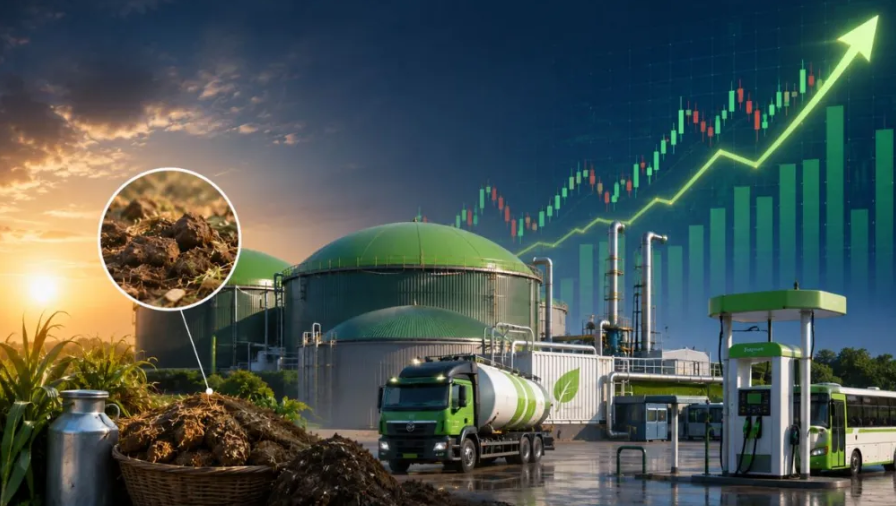
India’s Rs 23,731 crore GOBARdhan scheme could mark a major turning point for the country’s compressed biogas (CBG) industry, creating a larger growth runway for companies such as Praj Industries, Mahanagar Gas (MGL) and TruAlt Bioenergy. The government’s ambitious programme is designed to nearly ten-fold domestic CBG production by FY2035-36 while creating stronger demand, pricing visibility, financing support and infrastructure for the sector.
Approved by the Union Cabinet on August 6, 2026, GOBARdhan — or the National Circular Bioenergy Scheme — will run from FY2026-27 to FY2035-36. The initiative brings several earlier CBG-related programmes under a unified framework administered by the Ministry of Petroleum and Natural Gas.
The scale of the programme matters because India’s CBG sector has long faced challenges ranging from high upfront investment and feedstock aggregation to uncertain offtake and infrastructure gaps. GOBARdhan attempts to address those bottlenecks simultaneously.
Why the Rs 23,731 Crore GOBARdhan Scheme Matters
The central objective of GOBARdhan is to transform agricultural residue, cattle dung, press mud, municipal organic waste and other biomass into CBG and organic manure.
The government estimates that the scheme could deliver nearly ten-fold growth in domestic CBG production while attracting large-scale private investment.
The programme is built around six major growth engines:
- Assured CBG offtake
- Stable CBG pricing
- Capital assistance
- Pipeline infrastructure
- Credit guarantee support
- A CBG ecosystem challenge fund
Together, these measures seek to make CBG projects more bankable and predictable.
The government has also established a CBG obligation trajectory for city gas distribution entities, with procurement targets of 3% in FY2026-27, 4% in FY2027-28 and 5% from FY2028-29 onward for CNG transport and domestic PNG segments.
That creates something the industry has needed for years: a clearer long-term demand signal.
Praj Industries: Technology Could Become a Major Beneficiary
Praj Industries is among the companies that could benefit as India expands its CBG ecosystem.
CBG is already an important part of Praj’s bioenergy portfolio. The company has developed technology aimed at improving biogas yields and reducing operating costs, while also exploring different feedstocks and international opportunities.
The significance of GOBARdhan for technology providers is straightforward: a rapid increase in CBG capacity means greater demand for plant engineering, technology, processing systems and related infrastructure.
Praj’s experience across bioenergy could therefore position it to participate in multiple stages of the expansion.
The company itself highlighted the Cabinet’s approval of the Rs 23,731 crore GOBARdhan scheme as an industry development in its latest investor presentation, describing the policy as a catalyst for accelerating CBG production through assured offtake, stable pricing, capital assistance, pipeline connectivity and access to finance.
MGL Could Benefit From the Demand Side
Mahanagar Gas (MGL) represents another part of the CBG opportunity: the city gas distribution network.
The importance of CGD companies is increasing because GOBARdhan’s offtake mechanism is designed around procurement by city gas distribution entities.
That creates a stronger connection between CBG producers and end-use markets such as CNG transport and domestic PNG.
For companies operating CGD networks, increased CBG availability could provide an additional source of renewable gas while helping diversify the fuel mix.
The government’s CBG obligation trajectory could gradually turn renewable gas procurement into a structural component of the city gas business rather than an isolated pilot activity.
TruAlt Bioenergy: From Plant Operations to Expansion
TruAlt Bioenergy is another company that sits closer to the CBG production side of the value chain.
According to industry coverage, CBG is a key growth area for TruAlt, with the company using feedstocks such as sugarcane press mud and spent wash. Its strategy involves locating plants close to raw-material sources to improve feedstock economics.
TruAlt currently operates a CBG plant in Karnataka and has outlined a larger CBG project pipeline.
For developers such as TruAlt, the biggest significance of GOBARdhan could be the improvement in project economics.
Capital assistance of up to Rs 2 crore per tonne per day (TPD) of installed CBG capacity is available for eligible greenfield projects, with support extending to important value-chain assets. Brownfield capacity expansions are also eligible.
Stable Pricing Could Change the Investment Equation
One of the most important elements of GOBARdhan is the introduction of a stable administered CBG price of Rs 2,110 per MMBTU, supported through a government-backed pricing framework.
The framework is intended to provide revenue visibility over a minimum 10-year horizon.
For investors and lenders, predictable revenue can be just as important as the size of the subsidy.
CBG projects require substantial upfront investment in plant construction, feedstock collection, purification systems and logistics. If future revenues are difficult to predict, securing financing becomes harder.
A longer-term pricing framework could therefore make it easier for viable projects to reach financial closure.
Assured Offtake Addresses One of CBG’s Biggest Challenges
Producing CBG is only one part of the equation. Developers also need reliable buyers.
GOBARdhan directly addresses this issue through its offtake assurance framework.
City gas distribution companies are expected to play a central role in absorbing CBG production, while pipeline connectivity will help connect plants with trunk pipelines and CGD networks.
This could significantly improve the economics of projects located near major gas networks.
For producers, assured demand reduces market uncertainty. For CGD companies, it creates access to domestically produced renewable gas.
The result could be a more integrated CBG ecosystem connecting farmers → biomass aggregators → CBG plants → gas networks → consumers.
Pipeline Infrastructure Could Unlock More Projects
Infrastructure has been another major constraint for India’s CBG ambitions.
A CBG plant may be technically capable of producing fuel, but transporting that fuel economically to customers can become challenging if the necessary infrastructure is unavailable.
GOBARdhan includes support for cluster-based and standalone pipeline infrastructure connecting CBG plants with trunk pipelines and city gas distribution networks.
Better connectivity could reduce evacuation costs and allow plants to operate at higher utilisation levels.
It could also make new projects viable in locations that previously lacked a practical route to market.
Credit Guarantees Could Bring More Developers Into the Sector
Another important element is the proposed credit guarantee mechanism.
The government wants to strengthen lender confidence and expand institutional financing for eligible MSME-based CBG projects.
This could be particularly important because the CBG industry is not limited to large corporations. Smaller developers, cooperatives and rural entrepreneurs could also participate if financing becomes more accessible.
By reducing some lending risks, the credit guarantee structure could broaden the pool of potential CBG developers.
India’s Energy Security Adds to the Opportunity
The CBG push is also closely linked to India’s energy security strategy.
India currently imports nearly half of its natural gas requirement, according to the government. Increasing domestic production of renewable gas could therefore reduce exposure to international fossil-fuel markets.
CBG is particularly attractive because it can be integrated into the existing gas ecosystem.
Instead of depending entirely on imported natural gas, India can use domestic organic resources to produce a renewable alternative.
That creates a dual benefit: waste management and energy production.
Rural India Could Become Part of the Energy Value Chain
The GOBARdhan programme is not simply an energy policy.
Its wider ambition is to create a circular rural economy around agricultural waste and organic resources.
Farmers can potentially earn from agricultural residue. Feedstock aggregators can develop new businesses. CBG plants can generate local employment, while organic manure from the process can support agriculture.
The government has specifically positioned the programme as a mechanism for creating new income opportunities for farmers, rural entrepreneurs and other participants in the biomass value chain.
This could make CBG expansion relevant far beyond listed energy and engineering companies.
The CBG Opportunity Is Large, but Execution Will Matter
Despite the scale of the announcement, GOBARdhan does not guarantee that every CBG project will succeed.
Feedstock availability remains a critical consideration. Biomass must be collected, transported and processed consistently throughout the year.
Plant utilisation, logistics, technology efficiency, financing costs and proximity to gas networks will continue to determine project profitability.
The government itself is attempting to address several of these issues through the ecosystem challenge fund, which will support feedstock mapping, aggregation infrastructure, technology adoption, process improvement and district-level CBG planning.
Therefore, the next phase will be less about announcing projects and more about executing commercially viable projects at scale.
What the GOBARdhan Push Means for Investors
For investors tracking India’s clean-energy transition, the GOBARdhan scheme creates a new thematic opportunity.
The potential beneficiaries span several parts of the value chain:
Technology providers: Companies such as Praj could benefit from increased demand for CBG technology and engineering.
Gas distributors: Companies such as MGL could gain from greater availability of domestic renewable gas within CGD networks.
CBG producers: Developers such as TruAlt could benefit from capital assistance, improved offtake certainty and better financing conditions.
However, investors should distinguish between policy opportunity and company-specific financial performance. The success of a company will still depend on execution, project economics, balance-sheet strength, feedstock access and the pace at which projects become operational.
India’s CBG Boom Could Be Just Beginning
The Rs 23,731 crore GOBARdhan programme represents a significant policy shift for India’s CBG industry.
Instead of relying on fragmented incentives, the government has created a national framework covering demand, pricing, capital expenditure, financing and infrastructure.
That could provide the foundation for the sector to move from pilot projects to larger-scale commercial deployment.
With a target of nearly ten-fold growth in domestic CBG production by FY2035-36, the potential market is substantial.
For companies such as Praj Industries, MGL and TruAlt Bioenergy, the opportunity will depend on how effectively they capture their respective positions in the emerging value chain.
If implementation matches policy ambition, India’s waste-to-energy economy could become an increasingly important part of the country’s clean-energy transition.
India’s Rs 23,731 crore GOBARdhan scheme sends a powerful signal that compressed biogas is moving toward the mainstream of the country’s energy strategy.
The combination of assured offtake, stable pricing, capital assistance, pipeline infrastructure and credit support could address many of the barriers that have historically slowed CBG development.
For Praj Industries, the opportunity lies in technology and engineering. For MGL and other city gas distributors, the focus is likely to be on integrating renewable gas into existing networks. For TruAlt Bioenergy and other producers, the new framework could improve the economics of expanding CBG capacity.
The real test, however, will be execution.
If India can translate the GOBARdhan policy framework into commercially successful plants, reliable feedstock networks and functioning gas infrastructure, the country could see a substantial CBG boom over the next decade.