0
0
 0
0
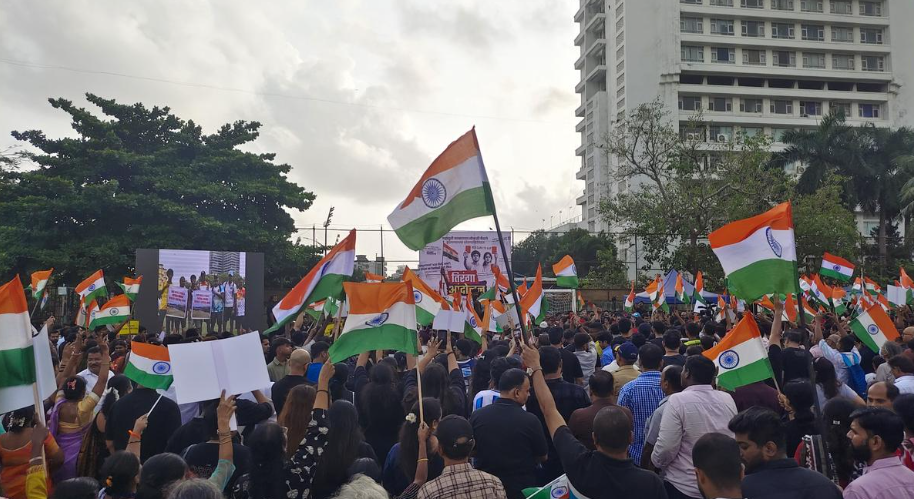
Mumbai’s football community has intensified its opposition to the Brihanmumbai Municipal Corporation (BMC) proposal to convert the Neville D’Souza Football Ground in Bandra Reclamation into a convention and exhibition centre. Footballers, coaches, parents, club officials and residents have gathered in protest, arguing that the redevelopment would take away one of the city’s important football facilities at a time when Mumbai is already facing a shortage of open sporting spaces.
The controversy surrounding the Bandra football ground has escalated after the BMC general body approved a proposal to change the site’s reservation from a playground to a convention and exhibition centre. The decision has triggered strong reactions from Mumbai’s football fraternity and prompted legal action.
The Bombay High Court has since ordered the authorities to refrain from taking further steps on the proposed conversion until the next hearing, providing a temporary reprieve for the football community.
Football Community Shows ‘Red Card’ to BMC Plan
The latest protest took place at the Neville D’Souza Football Ground, where hundreds of footballers, coaches, parents, students and football enthusiasts gathered.
Protesters dressed in black and held up red cards as a symbolic message to the civic authorities. The demonstration was organised under the banner of the ‘Tiranga Andolan’ and led by Aaditya Thackeray, who is also president of the Mumbai Football Association (MFA).
The symbolism was deliberately linked to football: the community wanted to make it clear that the proposed change was viewed as a red card for the city’s football development.
For players and coaches, however, the dispute is about more than one piece of land.
They argue that losing the Bandra ground could reduce opportunities for young footballers to train, compete and develop their skills.
Why Neville D’Souza Ground Is Important
The Neville D’Souza Football Ground is located in Bandra Reclamation and occupies approximately 8,450 square metres.
The land belongs to the Maharashtra Housing and Area Development Authority (MHADA), while the Mumbai Football Association has used the facility for organised football after receiving a lease arrangement.
The venue was upgraded with a FIFA-standard artificial turf in 2018, making it one of Mumbai’s few dedicated full-sized football grounds.
Its importance goes beyond professional football.
Youth teams, senior teams, women’s squads, academies and local clubs have all used the ground for training and competition.
Reports have indicated that thousands of footballers use the facility, making it a crucial part of Mumbai’s football ecosystem.
BMC Approves Change From Playground to Convention Centre
The dispute intensified after the BMC approved a proposal to alter the reservation of the Bandra ground.
The BMC general body cleared the proposal on August 18, 2026, changing the land-use reservation from a playground to a convention and exhibition centre.
The move has sparked concerns among football stakeholders because the ground is regarded as one of the city’s few full-sized football facilities.
Opponents say the decision comes at a time when Mumbai urgently needs more public spaces for sport and recreation.
They argue that removing an existing football facility without providing an equivalent replacement could make it more difficult for young players to develop.
Footballers Warn of the Impact on Young Players
Coaches and players have repeatedly emphasized that football development depends on access to proper grounds.
Young players need regular training facilities to develop technical ability, fitness and match experience.
Without sufficient grounds, academies may be forced to reduce training sessions or move farther away from central areas.
Parents have also expressed concerns because the Bandra ground is used by children and young footballers.
The protest therefore has become a broader discussion about whether major Indian cities are providing enough sporting infrastructure for the next generation.
Mumbai Already Faces an Open-Space Shortage
The controversy has also highlighted Mumbai’s broader shortage of public open spaces.
Urban planners have opposed the proposed conversion, arguing that replacing a playground with a built-up convention or exhibition facility would further reduce recreational space in a city that already has limited open areas.
According to Urban Centre Mumbai, Mumbai has around 0.88 square metres of open space per person, substantially below several planning recommendations cited by the group.
This has strengthened arguments from residents and sports groups that existing public sporting facilities should be protected.
BMC and Supporters of the Plan Offer a Different View
The BMC proposal has also received a different interpretation from supporters of the redevelopment.
BJP corporator Swapna Mhatre has argued that the decision is intended to correct the land reservation rather than simply remove a football ground.
According to her explanation reported by ThePrint, the land had originally been reserved for a convention centre in an earlier development plan. Its temporary use as a football ground followed changes made over the years.
Mhatre also said the land is owned by MHADA and that the BMC’s role relates to the Development Plan reservation.
She argued that a convention or exhibition centre could create employment and that another site could potentially be developed as an international-level football ground.
That position has done little to calm the football community, which wants the existing facility preserved.
MHADA Says Convention Centre Could Support Housing
MHADA has also defended the proposal.
The housing authority has said that the use of the 8,450-square-metre site as a playground was temporary and that income from a proposed convention centre could be directed toward affordable housing projects.
This creates a central tension in the dispute.
On one side, authorities point to potential economic and housing benefits from redevelopment.
On the other, footballers, parents and residents argue that public sporting infrastructure should not be sacrificed for commercial or development purposes.
Football Association Takes Legal Route
The Mumbai Football Association has not limited its opposition to street protests.
Following the BMC’s decision, the football fraternity moved to challenge the reservation change in the Bombay High Court.
The legal challenge added another dimension to the controversy.
The football community is seeking to prevent the implementation of the decision and protect the ground’s status as a sporting facility.
The court subsequently ordered the authorities to refrain from taking further action on the conversion until the next hearing.
The next stage of the legal battle will therefore be closely watched by Mumbai’s football community.
Why the Ground Matters to Indian Football
The argument over the Bandra football ground also reflects a much bigger issue in Indian football: infrastructure.
India has a huge population and a large number of young people interested in football, but quality playing facilities remain unevenly distributed.
Mumbai is one of India’s traditional football centres, with a long history of clubs, academies and competitive leagues.
Removing one of its key full-sized grounds could make an already difficult situation even more challenging.
Football development requires more than talented players.
It requires pitches, coaches, academies, competitions and regular access to training facilities.
Neville D’Souza’s Legacy Adds Emotional Weight
The ground carries the name of Neville D’Souza, one of India’s most prominent footballers from the country’s early international era.
D’Souza was part of the Indian team that achieved its historic fourth-place finish at the 1956 Melbourne Olympics, still India’s best-ever Olympic football result.
The ground was named after him in 2015 by the Mumbai football association.
For members of the football community, protecting the venue therefore also represents preserving part of Mumbai and India’s football heritage.
Neville D’Souza’s son Nigel has also joined the campaign to save the ground, emphasizing the importance of giving children access to football facilities.
Political Leaders Join the Opposition
The dispute has also attracted political attention.
Aaditya Thackeray has strongly criticized the proposed conversion, arguing that Mumbai should be protecting sports grounds rather than reducing them.
NCP MLC Zeeshan Siddique has also urged the Maharashtra government to intervene and protect the ground.
He questioned how Indian football can develop if players lose access to proper grounds.
The involvement of political leaders has helped bring the issue beyond the football community and into the wider public debate over Mumbai’s urban planning priorities.
A Battle Between Development and Sports Infrastructure
At the heart of the controversy is a familiar urban-development question: how should valuable city land be used?
Convention and exhibition centres can generate economic activity, employment and revenue.
Sports grounds, meanwhile, provide social and health benefits that may be harder to measure financially.
For footballers and coaches, the Bandra ground represents an investment in future sporting talent.
For authorities, the proposed convention centre represents a potential development opportunity.
Finding a solution that addresses both concerns will be crucial.
What Happens Next?
The Bombay High Court’s interim intervention means the immediate conversion process has been paused.
The court has directed the authorities not to take further steps on the resolution until the next hearing.
The legal proceedings could determine whether the BMC’s reservation change can proceed.
Meanwhile, the football community is expected to continue campaigning for the ground to remain dedicated to sport.
The dispute has already attracted attention from players, coaches, parents, residents, politicians and urban planners.
Footballers, coaches, parents and residents in Mumbai are protesting the BMC’s decision to change the reservation of the Neville D’Souza Football Ground in Bandra from a playground to a convention and exhibition centre. The ground is one of Mumbai’s few full-sized football facilities and is used by thousands of players across different age groups.
The controversy intensified after the BMC general body approved the proposal in August 2026. The football fraternity subsequently challenged the decision in the Bombay High Court, which has temporarily halted further action.
For authorities, the proposed convention centre could support employment, economic activity and affordable housing initiatives. For footballers and residents, however, the Neville D’Souza ground represents something equally important: a rare space where Mumbai’s football future can be developed.
The ongoing legal and public campaign will determine whether the historic Bandra football ground remains a sporting venue or eventually makes way for a new convention and exhibition facility.